The challenge
Plant hire isn’t the same as booking a hotel room or buying a product online.
A customer might need a machine for a day, several days or indefinitely. Different hire periods attract different rates. Equipment has to be available for the entire requested period. Deposits need to be collected and potentially deducted from. Existing hires can be extended. Trade customers have different requirements from occasional customers. Then there are deliveries, collections, handovers, identification documents and communication to manage.
Most conventional WordPress booking plugins aren’t designed for any of that.
LJM needed a website that made hiring plant straightforward for the customer without creating an administrative headache behind the scenes.
It also needed to reflect the business properly. This wasn’t about creating another generic construction website with a contact form and a list of machines. The site needed to feel established, dependable and deliberately built around plant hire.
The approach
We started with the hire journey rather than the website.
Before designing pages, we mapped what needed to happen from the moment somebody decided they needed a machine through to its eventual collection.
That meant considering availability, hire duration, pricing, customer details, deposits, delivery, documentation, extensions and the operational information LJM would need internally.
From there, we built two connected parts of the project: a completely custom WordPress website for the customer-facing experience and a bespoke plant rental system for everything happening underneath it.
Because both were developed together, booking isn’t something bolted onto the website. It’s part of the website.
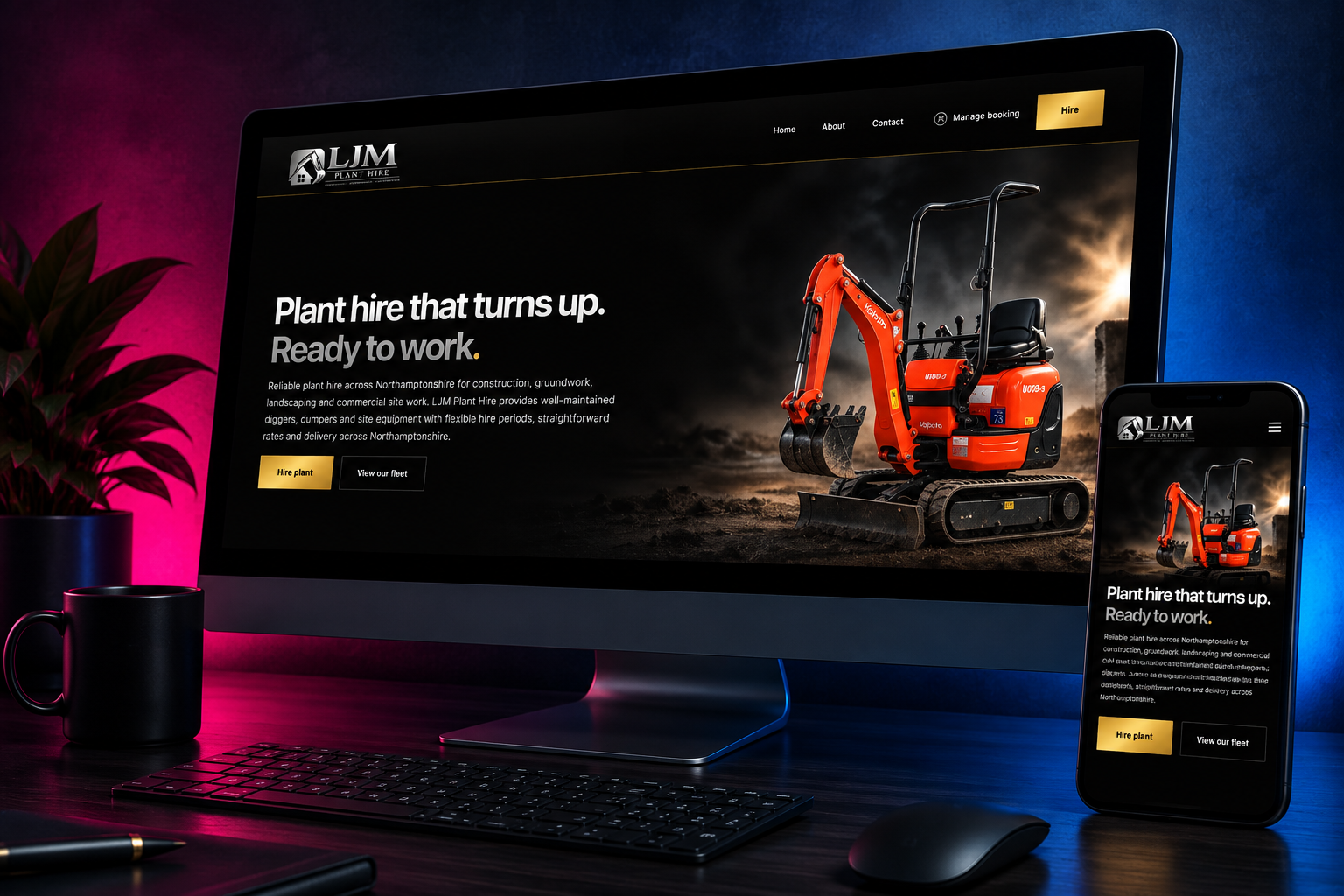
A website designed around the machinery
The visual direction deliberately moves away from the generic template look common across the sector.
Deep blacks, metallic detailing and restrained gold accents give the site a stronger industrial identity, while large-scale plant photography puts the machinery at the centre of the experience.
The design is intentionally straightforward. Customers aren’t visiting a plant hire website to admire complicated navigation. They want to understand what is available, what it costs and how quickly they can get it.
Clear typography, strong calls to action and a simple page structure keep the route into the hire process obvious throughout the site.
And because a significant proportion of customers will arrive from their phone while on site, in a vehicle or away from a desk, the entire experience was designed to work properly on mobile rather than treating mobile as an afterthought.
Building the booking platform from scratch
The biggest part of the project sits behind the visible website.
Rather than adapting an existing rental plugin and accepting its limitations, AMB360 developed a bespoke WordPress plant hire system specifically for LJM.
Each item can carry its own hire rules and pricing, including minimum and maximum hire periods and different rates for daily, multi-day and weekly bookings.
Availability is calculated against existing hires, helping prevent equipment from being booked when it is already committed elsewhere.
Customers can choose their equipment, select their required dates and progress through a purpose-built booking journey without needing to phone or send an enquiry simply to establish whether something is available.
It turns the website from an online brochure into an operational part of the business.
Hire pricing that reflects the real world
Plant hire pricing rarely works as a simple price multiplied by a number of days.
The platform therefore supports different pricing structures depending on the length of the hire, allowing LJM to configure daily, two-day, three-day and weekly rates rather than relying on a crude flat calculation.
Minimum and maximum hire periods can be controlled at item level, while promotional pricing and voucher codes give the business additional commercial flexibility.
Delivery is incorporated into the booking journey too, so the customer receives a much clearer picture of their hire before committing.
Deposits built into the process
Deposits are an important part of protecting plant and managing risk, so they were treated as a core part of the system rather than an additional payment field.
The platform records deposits against individual bookings and maintains a deposit ledger for LJM.
Where only part of a deposit needs to be retained, partial deductions can be recorded rather than forcing an all-or-nothing decision.
That gives LJM a clearer audit trail while making the process easier to manage when equipment is returned.
Digital handover and documentation
A hire doesn’t stop when somebody presses the booking button.
The system includes digital handover functionality designed to create a clearer record around equipment leaving and returning to the business.
Customer documentation and identification can be uploaded as part of the process, reducing reliance on disconnected emails, messages and paperwork.
Bringing that information into the hire record means LJM has a much clearer view of the customer, equipment and supporting documentation associated with each booking.
Hire extensions
One of the obvious problems with conventional booking software is what happens when a customer decides they need the machine for longer.
For LJM, we built online hire extensions into the platform.
Customers can request additional hire time, with the extension appearing within the management system for approval and processing.
Crucially, the system can consider the wider booking schedule rather than treating an extension as an isolated request. That helps LJM manage the operational impact when equipment is already expected elsewhere.
Open-ended and repeat hires
Not every customer knows exactly when a job will finish.
The platform therefore supports open-ended hires alongside conventional fixed-date bookings, giving LJM the flexibility required for longer or less predictable projects.
Repeat hire functionality also reduces unnecessary friction for returning customers. Instead of treating every hire as an entirely new relationship, the system is designed to make subsequent bookings easier to manage.
For a business where repeat customers can represent a significant proportion of ongoing work, that matters.
Quotes and trade customers
Not every hire should go directly through a standard online checkout.
The system includes quote functionality for customers or jobs requiring a more tailored approach, allowing LJM to manage opportunities that fall outside a straightforward online booking.
Trade accounts are supported too, creating the foundations for different relationships with regular commercial customers.
It means the platform can support both ends of the customer base: somebody who needs a machine for a short job and a trade customer hiring equipment repeatedly.
A customer portal
Once somebody has booked, they shouldn’t have to search through old emails every time they need information.
The customer portal gives users a dedicated place to manage their relationship with LJM, including their existing hires and relevant booking information.
That same principle carries through the wider platform: information should live where people expect to find it.
The less time customers spend chasing information, the less time LJM needs to spend supplying it manually.
Live operational management
Behind the customer-facing experience is a management environment built for the people actually running the hires.
A live dispatch board provides visibility across equipment movements and active bookings, helping LJM understand what is going out, what is currently on hire and what is expected back.
Bookings can be searched, edited and managed centrally rather than being scattered across form submissions and inboxes.
That operational layer was important. There is little value in making online booking easier for customers if every booking subsequently creates more work for the business.
Automated communication
Communication is another area where hire businesses can quickly lose time.
Booking notifications are built into the platform, with email infrastructure configured around LJM’s own domain and booking workflow.
WhatsApp booking notifications have also been incorporated into the system, reflecting the way customers and plant businesses increasingly communicate in practice rather than forcing every interaction through email.
The objective isn’t automation for the sake of it. It’s to remove repetitive administration while keeping customers informed.
Built specifically for LJM
One of the advantages of developing the platform ourselves is that LJM isn’t locked into the roadmap of a generic third-party rental product.
Features have been added because they solve genuine operational requirements: deposit management, hire extensions, open-ended hires, trade accounts, quotes, repeat hires, digital handovers, customer documentation, promotional pricing and dispatch management.
And because the booking platform and website have been developed as one system, the experience can continue evolving as the business does.
The result
LJM Plant Hire now has considerably more than a new website.
It has a digital hire platform designed around the complete lifecycle of a plant booking, from somebody discovering a machine through to availability, pricing, booking, documentation, deposit management, communication, extension and eventual return.
For customers, that means fewer barriers between needing plant and getting it booked.
For LJM, it means more of the hire process can be managed from one place, with less reliance on disconnected forms, messages, spreadsheets and manual administration.
And for us, it’s exactly the sort of website project we like building.
Not a brochure with a booking button attached. A working piece of the business.