The challenge
Launching a new plant and tool hire business requires more than a website that looks the part. It requires a digital infrastructure capable of supporting the way customers discover equipment, check availability, make bookings and manage their hires.
For HireGo Tool & Plant Rentals, the ambition was to create a professional, accessible and commercially capable online platform from the outset.
The business needed to serve a broad customer base, from tradespeople requiring specialist equipment for ongoing projects through to individuals hiring tools for shorter jobs. With machinery ranging from handheld power tools to substantial plant equipment, the website needed to make a complex catalogue feel straightforward.
But the bigger challenge sat behind the website.
Equipment hire operates very differently from conventional ecommerce. Hire periods vary, availability needs to be managed against existing reservations, pricing changes depending on duration and customers may require delivery, collection or additional hire time.
An ordinary WordPress website with a contact form wasn’t going to deliver the experience HireGo needed.
The objective was to create a platform that looked and felt like an established national hire brand while providing the specialist functionality of a dedicated equipment rental system.
The approach
We approached HireGo as a complete digital development project, bringing together website strategy, user experience, visual design and bespoke software engineering.
Rather than designing a website and attempting to attach booking functionality afterwards, we considered the entire hire journey from the beginning.
How would somebody find a particular machine? How would they understand its capabilities? How would they select their hire dates, check availability and progress into a booking? And how could the business manage those transactions without creating unnecessary administration?
These questions informed every stage of the project.
We developed a bespoke WordPress theme alongside a specialist rental management plugin, creating a connected platform where the equipment catalogue, product pages, checkout and underlying booking functionality work together.
The intention was simple: make hiring equipment easier for customers while giving HireGo the technology needed to operate efficiently and grow.
A website designed around the equipment
The visual direction for HireGo was deliberately confident, contemporary and commercially focused.
We wanted to avoid the generic appearance often associated with smaller plant hire websites, where outdated layouts, inconsistent equipment imagery and cluttered navigation can undermine the quality of the business.
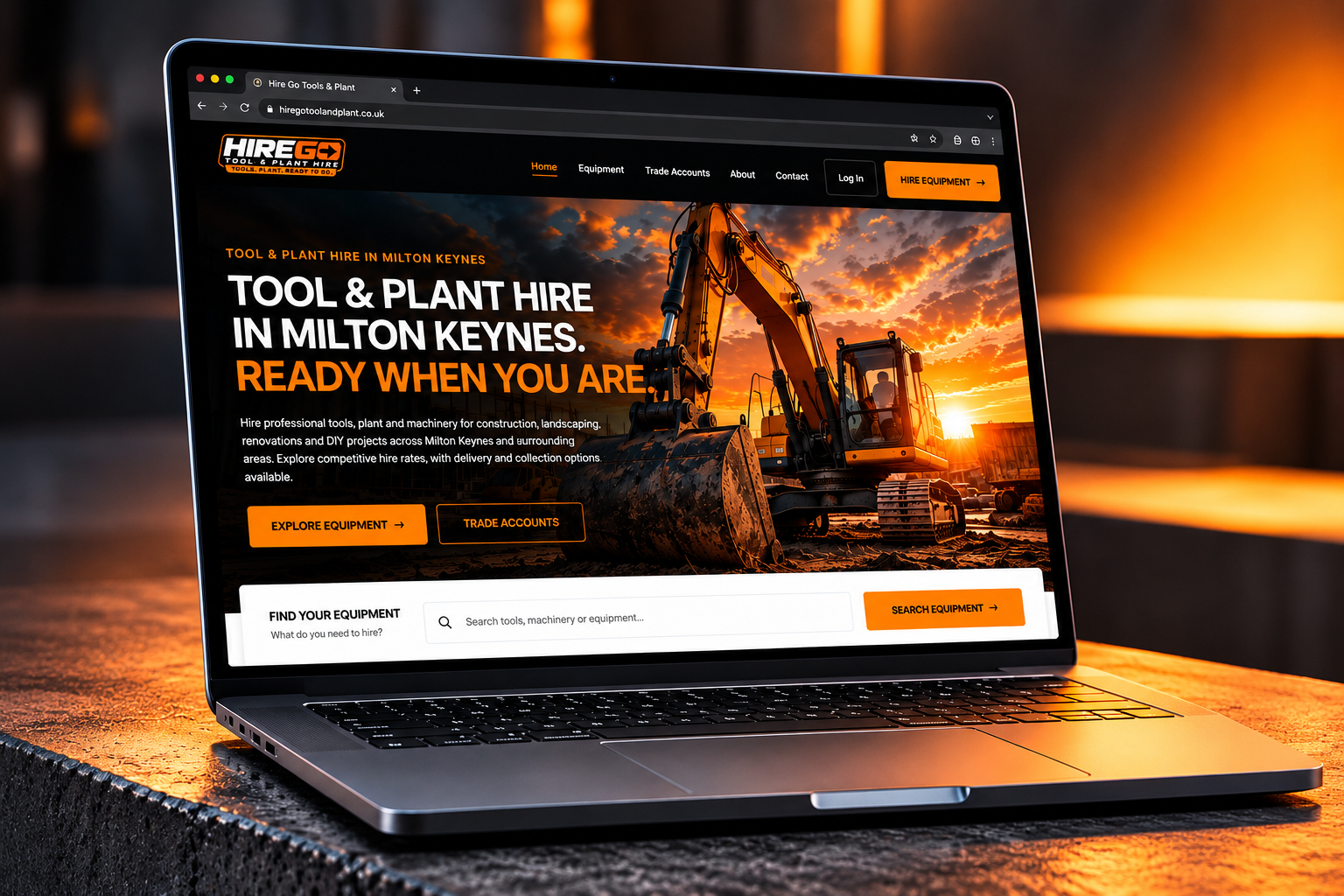
Instead, we created a distinctive design built around strong typography, generous spacing, high-quality machinery photography and clear calls to action.
The homepage immediately introduces the HireGo proposition through a prominent hero section, supported by an integrated equipment search experience.
Rather than forcing customers to navigate several pages before finding what they need, the search interface is positioned as a central part of the opening experience.
The remainder of the homepage introduces the equipment categories, explains delivery and collection arrangements and guides visitors towards the wider hire catalogue.
Every element has a purpose. The website needed to establish credibility, communicate the range of equipment available and make the next step obvious.
Making a complex catalogue feel simple
One of the biggest considerations was how to present an extensive range of tools and plant machinery without overwhelming customers.
HireGo covers everything from smaller power tools and access equipment through to landscaping machinery, cleaning equipment, generators, lifting equipment and substantial plant.
We developed a structured equipment catalogue with clearly defined categories, dedicated imagery and an intuitive browsing experience.
A bespoke equipment hire page brings the catalogue together, allowing customers to search and filter machinery according to their requirements.
Individual product pages provide a consistent presentation of equipment information, helping customers understand what each machine is designed for and how to begin the hire process.
We also developed equipment imagery and detailed product descriptions across the catalogue, creating a more professional and cohesive presentation.
The objective wasn’t simply to make the catalogue look attractive. It was to remove unnecessary friction between somebody needing equipment and finding the right machine.
Bespoke product pages built for hire
Conventional ecommerce product pages are designed around purchasing something outright. Equipment rental requires a different approach.
For HireGo, we developed dedicated product templates that place the machinery and hire journey at the centre of the experience.
Each product page combines equipment imagery, relevant specifications, descriptive content and clear booking actions.
Customers can move directly from an individual product into the dedicated hire checkout, with the selected equipment carried into the booking process automatically.
This avoids the frustrating experience of finding a machine, clicking to book and then having to locate the same product again.
The system also accommodates equipment where pricing needs to be provided individually, directing customers towards an enquiry rather than displaying an unsuitable fixed price.
It’s a more considered approach that recognises the differences between hiring a small power tool and arranging specialist plant machinery.
Developing the rental booking platform
The most technically significant element of the project was the specialist booking system sitting behind the website.
We developed and configured a dedicated WordPress rental plugin to support HireGo’s equipment hire operations, integrating it directly with the custom theme and customer-facing booking journey.
Unlike a conventional ecommerce checkout, the platform is designed around rental periods, equipment availability and the operational requirements of hiring machinery.
The system provides the foundations for managing individual equipment bookings, hire durations, customer information, deposits and ongoing reservations.
Different equipment can be configured with appropriate hire rules, including minimum and maximum rental periods and pricing structures that reflect the length of the booking.
Availability management is particularly important, helping ensure equipment reservations can be considered against existing hires.
By building the website and rental functionality as connected parts of the same platform, we created a much more natural customer journey than would be possible with a generic booking form.
A dedicated checkout experience
Booking equipment should feel straightforward, regardless of the complexity involved behind the scenes.
We developed a dedicated checkout template specifically for HireGo, rather than relying on the standard WooCommerce purchase experience.
When customers select equipment from an individual product page, the relevant product information is passed into the checkout journey.
The interface is designed to support the specialist requirements of equipment rental, including hire dates and the information needed to process a booking.
This creates a clearer transition from browsing to booking and provides the foundations for a more complete self-service hire experience.
We also refined navigation behaviour, product links and page interactions to make the journey more consistent across the website.
The result is a booking experience designed for hiring machinery rather than purchasing ordinary retail products.
Flexible pricing and hire management
Plant and tool hire rarely follows a simple one-price-fits-all model.
A customer might need a machine for a single day, several days or an extended period. Different equipment can carry different rates and minimum hire requirements.
The rental platform supports configurable pricing and duration rules, allowing HireGo to manage its equipment according to the commercial realities of the business.
The underlying system also incorporates functionality for more complex arrangements, including hire extensions, open-ended hires, repeat bookings and trade customer requirements.
This flexibility is important because equipment hire needs to accommodate the unpredictable nature of construction, landscaping and maintenance work.
Jobs overrun, requirements change and customers frequently need additional time.
Rather than forcing every booking into a rigid structure, the platform has been designed to support a broader range of rental scenarios.
Bringing operations together
The platform isn’t solely concerned with what customers see.
Behind the website, the rental management functionality provides a structured environment for handling equipment bookings and associated customer information.
Deposit management, booking records, availability and hire administration form part of the wider system.
The technology also provides support for quotation workflows and repeat customer relationships, giving HireGo the foundations to manage both occasional customers and ongoing commercial accounts.
This operational functionality is what transforms the project from a conventional website into a genuine business platform.
Instead of treating the website as a separate marketing channel, the aim is to make it an active part of how the business manages its hire activity.
Built for local delivery and collection
HireGo operates within approximately 30 miles of Milton Keynes, making clear delivery and collection information an important part of the customer experience.
We incorporated this into the website’s structure, ensuring customers can understand the service area and how equipment can be supplied.
The website was designed to support customers who know exactly what they need, as well as those who may require guidance before arranging a hire.
By making the service proposition clear and keeping equipment discovery straightforward, the platform helps customers move from an initial requirement towards a booking or enquiry.
Designed for mobile from the outset
For a plant hire business, mobile usability isn’t optional.
Customers are frequently working on site, travelling between jobs or checking equipment requirements away from a desk.
We developed the HireGo website with responsive layouts, mobile-friendly navigation and equipment browsing interfaces that adapt across different screen sizes.
Particular attention was given to the presentation of product pages, equipment imagery, booking actions and the transition into checkout.
We also worked through smaller interaction details, including unwanted page scrolling and the behaviour of booking links, to create a more polished experience.
The objective was to make the website just as practical for somebody standing on a construction site with their phone as it is for somebody arranging equipment from an office.
The development behind the experience
A significant amount of the work involved the technical integration between the bespoke WordPress theme and the specialist rental plugin.
We developed the core website templates, created the equipment catalogue structure, connected product booking actions to checkout and refined the underlying plugin functionality.
Along the way, we resolved PHP compatibility issues, corrected equipment image behaviour, improved calendar presentation and worked through the details of the customer booking journey.
We also developed a consistent approach to product imagery and descriptions, ensuring that equipment across different categories could be presented professionally.
This kind of development goes considerably further than installing a WordPress theme and adding content.
It requires an understanding of how the website, database, rental logic and customer interactions fit together.
For HireGo, those elements were treated as parts of one connected platform.
The result
HireGo has been built with a digital foundation designed to support the business from launch.
The project brings together a bespoke WordPress website, structured equipment catalogue, dedicated product pages, integrated search and filtering, specialist checkout experience and rental management technology.
For customers, the platform provides a clearer and more intuitive way to discover machinery and begin the hire process.
For the business, it creates the foundations for managing equipment availability, pricing, bookings, deposits and customer relationships through a connected system.
Perhaps most importantly, the website has been designed with the future in mind.
As HireGo expands its equipment catalogue, develops its customer base and introduces additional services, the platform provides the flexibility to continue evolving alongside the business.
Rather than starting with a basic website and attempting to solve operational challenges later, HireGo has invested in a more capable digital infrastructure from the beginning.
The AMB360 perspective
HireGo is a strong example of what happens when website development is approached as a business solution rather than simply a design project.
From the outset, our focus was on understanding how the business needed to operate and creating technology that could support those requirements.
That meant combining visual design with specialist software development, bringing together equipment discovery, product information, booking functionality and rental management into one connected experience.
The result is a platform that does considerably more than showcase a catalogue of tools and machinery.
We didn’t just build HireGo a website. We built the digital foundations of a plant and tool hire business.
AMB360. We build brands. Drive growth. Deliver results.