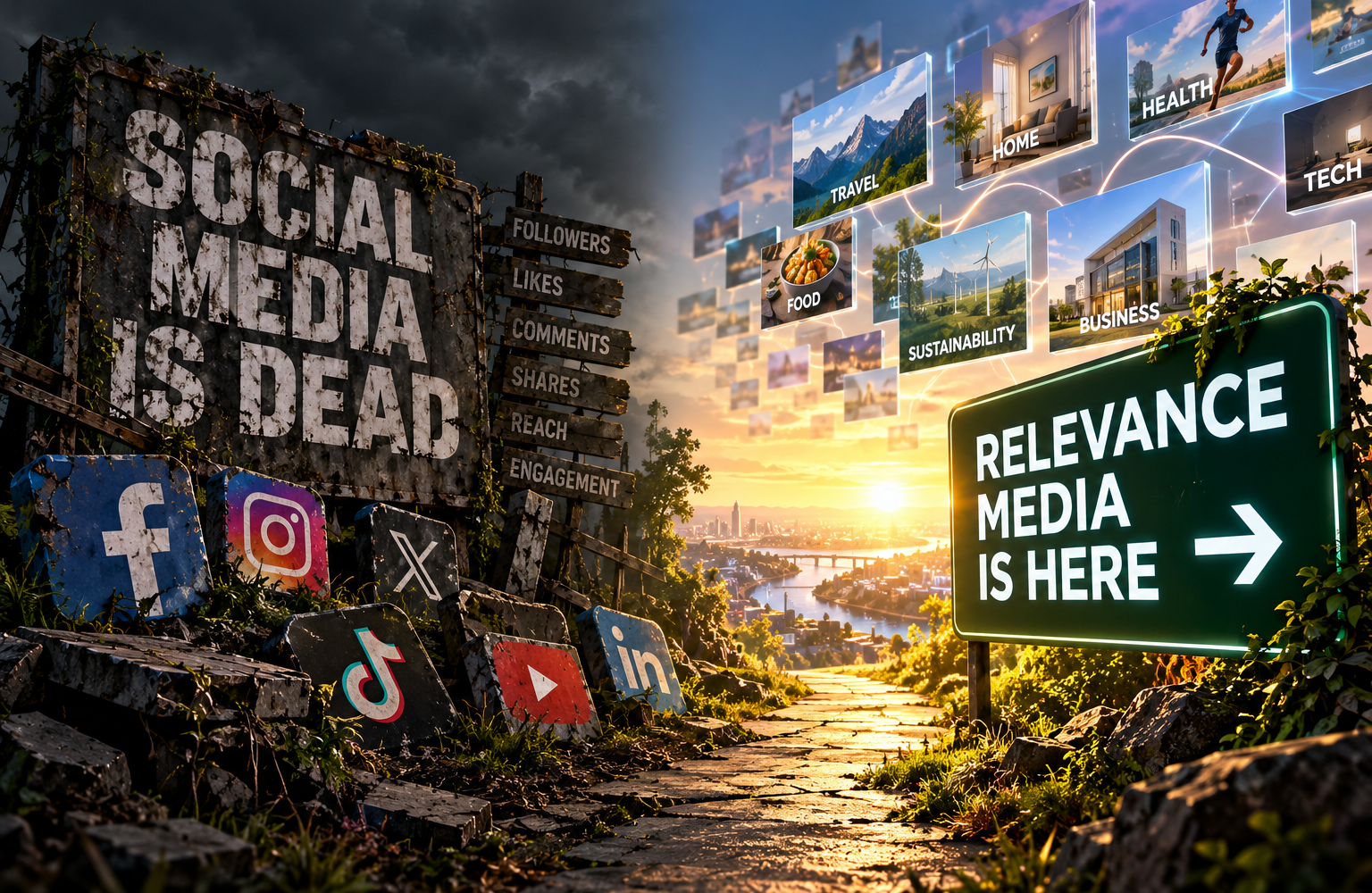

There’s a peculiar obsession in business with having a nice website. Not necessarily an effective website, or one that generates enquiries, attracts customers and contributes something meaningful to the bottom line. Just a nice one. Something modern, preferably with a few animations, some professionally photographed people looking vaguely enthusiastic in a meeting room and a homepage proudly announcing that the company is passionate about delivering innovative solutions.
Lovely. But what does any of that actually achieve? You can spend thousands creating something that looks fantastic, impresses your colleagues and earns a few compliments on LinkedIn, but if it isn’t helping your business attract customers, generate opportunities or make money, you’ve got to question what you’ve actually invested in.
The uncomfortable reality is that an enormous number of business websites exist primarily to make their owners feel like they’ve got their marketing sorted. They look respectable, contain all the expected information and tick the necessary boxes, but nobody has stopped to ask whether they’re doing anything commercially useful. The website goes live, everyone congratulates themselves, somebody posts a screenshot on social media and the whole thing is promptly forgotten about until something breaks.
Meanwhile, potential customers are arriving, getting confused, losing interest and heading straight towards competitors who might not be anywhere near as good at what they do. Those missed opportunities don’t generate notifications, appear on invoices or show up neatly in the accounts. They simply disappear, and the business carries on without ever knowing what it could have won.
A pretty website that doesn’t convert is just an expensive decoration
Good design matters enormously, and anyone suggesting otherwise probably shouldn’t be anywhere near a website project. But there’s a significant difference between design that looks good and design that actually works. A beautiful website can still have dreadful messaging, confusing navigation, weak calls to action and absolutely no understanding of what its visitors are trying to achieve.
We’ve seen businesses obsess over whether a button should be blue or green while completely ignoring the fact that nobody has a compelling reason to click it in the first place. They’ll spend hours debating typography, photography and whether the homepage needs another animation, yet give remarkably little thought to what happens when somebody arrives looking for a particular service. It’s a spectacular way of concentrating on the things that are easiest to have an opinion about while neglecting the things that actually matter.
The purpose of design isn’t simply to make something attractive. It’s to communicate information clearly, establish credibility, create a logical experience and help people make decisions. If your website looks incredible but visitors can’t immediately understand what you do, who you help or why they should choose you, the design isn’t doing its job.
A properly considered website strategy starts with the business, its customers and the commercial outcomes the website is supposed to support. Everything else, from the visual identity to the structure of individual pages, should contribute towards those objectives. If your entire brief can be summarised as we want something modern and professional, you’ve barely started thinking about the problem.
Nobody cares about your business as much as you do
That might sound harsh, but it’s something more business owners need to understand. You know how hard you’ve worked, how experienced your team is and how much effort goes into delivering your services. You’ve lived through the difficult years, the demanding customers, the late nights and the decisions that helped build the business into what it is today.
Your potential customers know absolutely none of that, and they aren’t particularly interested in finding out unless it helps them make a decision. They’ve arrived on your website with a problem, a requirement or a question, and they’re trying to establish whether you can help. They want to know what you do, whether you’re credible, whether you’ve handled similar work before and whether contacting you is worth their time.
Yet so many websites lead with paragraphs of corporate waffle that could have been generated by putting the words innovative, bespoke, solutions and excellence into a blender. You’ll read something along the lines of we pride ourselves on delivering customer-focused solutions tailored to the unique requirements of our valued clients, which sounds impressive until you realise it communicates precisely nothing. You could stick that sentence on the website of a plumbing company, an accountancy practice or a manufacturer of industrial adhesives and it would be equally meaningless.
If your homepage could have another company’s logo placed above it without anybody noticing, your messaging needs some serious attention. Good website copy isn’t about sounding clever, filling space or impressing the person who signed off the project. It’s about being understood, demonstrating relevance and giving somebody a convincing reason to choose your business over the alternatives.
Your competitors might be worse than you. They’re just better at selling themselves.
Here’s something that should irritate any decent business owner. Somewhere in your market, there’s probably a competitor delivering an inferior service, charging more money and winning customers you would have looked after considerably better. They might not have your experience, your capabilities or your standards, but they’re making it easier for potential customers to understand why they should get in touch.
Customers cannot properly assess the quality of a service they’ve never experienced, so they make decisions using the information available to them. A website that explains services clearly, demonstrates relevant experience, provides credible testimonials and makes the enquiry process straightforward immediately has an advantage over one that expects visitors to work everything out for themselves. That advantage has very little to do with which company is actually better at delivering the work.
It’s one of the reasons search visibility and SEO need to be considered alongside website performance. Getting found is important, but what somebody discovers when they arrive matters just as much. A prominent Google ranking is worth considerably less if the website behind it does a dreadful job of persuading anybody to take the next step.
Businesses sometimes assume their reputation will do the heavy lifting, particularly when they’ve grown through referrals and established relationships. That might work with people who already know them, but it’s a dangerous assumption when trying to reach new audiences. The people discovering your business for the first time don’t have the benefit of your history, and they certainly aren’t obliged to give you the benefit of the doubt.
The enquiries you’re losing don’t appear in your accounts
Most businesses can tell you what they paid for their website. They can probably tell you what hosting costs, how much they spend on advertising and what their marketing agency invoices every month. Ask them how much revenue their website loses through poor conversion performance, however, and the conversation tends to become considerably less precise.
It’s understandable, because measuring something that never happened is difficult. You don’t receive a notification when somebody decides your website looks unconvincing, and Google Analytics doesn’t produce a helpful report titled customers who thought your competitor looked more professional. What you can measure, though, is how people behave, where they abandon journeys and how effectively the website turns relevant visitors into meaningful enquiries.
Imagine your website attracts 2,000 visitors every month and converts 1% of them into enquiries. That’s 20 enquiries, which might sound perfectly respectable if you’ve never questioned whether the website could be performing better. Improve that conversion rate to 2% and you’re suddenly generating 40 enquiries from exactly the same number of visitors, without spending another penny attracting additional traffic.
Now imagine that a quarter of those additional enquiries become customers, each generating £2,000 in revenue. That’s another £10,000 per month, or £120,000 over a year if those results remained consistent. These are illustrative figures rather than a promise of what any particular website can achieve, but they demonstrate how relatively modest improvements can create substantial commercial opportunities.
The reverse is equally important. If your website could be converting more effectively but nobody is identifying or addressing the problems, the potential cost accumulates month after month. Unlike your hosting invoice, nobody sends you a bill for the customers who quietly disappeared, which makes the problem remarkably easy to ignore.
Stop celebrating traffic that achieves absolutely nothing
There’s something faintly ridiculous about businesses proudly announcing that website traffic has increased by 40% when nobody can explain whether any of those additional visitors became customers. The graph looks impressive, the report has plenty of green arrows and everyone gets to feel like something positive is happening. Whether the business is actually benefiting seems to become a secondary consideration.
Traffic matters, obviously, and strong organic visibility can be enormously valuable. But visits, impressions, rankings and clicks are indicators of activity rather than definitive measures of commercial success. A thousand people arriving to read an interesting article might deliver less immediate revenue than twenty people searching for the exact service you provide with a genuine intention to buy.
The same problem exists with lead generation. A campaign producing fifty enquiries isn’t necessarily outperforming one generating ten if most of those fifty enquiries are irrelevant, unqualified or never going to become customers. It’s perfectly possible to make marketing reports look increasingly impressive while the actual sales pipeline becomes progressively worse.
This is where digital marketing strategy needs to move beyond individual channels and start considering the entire customer journey. You need to understand where visitors come from, what they’re looking for, how they behave and whether the resulting enquiries contribute to business growth. Otherwise, you’re collecting increasingly sophisticated statistics about people who didn’t buy anything and calling it success.
Your homepage isn’t a dumping ground for everything you’ve ever done
We’ve all seen websites where the homepage appears to have been designed by a committee of people who were each determined to get their favourite section included. It starts with an enormous image, moves into a vague mission statement, introduces seventeen services, tells you the company history, displays a few team photographs and finishes with enough calls to action to make the whole experience feel like a particularly aggressive shopping channel.
Everything is apparently important, so nothing stands out. The business has spent so much time deciding what it wants to say that it’s forgotten to consider what visitors actually need to hear. The result is a page that contains plenty of information but provides remarkably little direction.
Someone arriving from Google with a specific service requirement shouldn’t have to navigate through your entire corporate identity before discovering whether you can help. Someone comparing suppliers shouldn’t need to hunt for examples of your work, and somebody ready to request a quotation shouldn’t be forced through an unnecessarily complicated series of pages. A properly structured website should recognise different visitor intentions and provide logical routes towards the information that matters.
Effective user experience isn’t about making everything animate when somebody moves their mouse. It’s about creating clarity, reducing unnecessary friction and helping visitors achieve what they came to do. If people need to work hard to understand your website, don’t be surprised when they decide they’ve got better things to do.
Trust isn’t built by repeatedly telling people you’re trustworthy
Another favourite of business websites is the endless collection of self-congratulatory claims. Apparently everybody is reliable, professional, experienced, passionate and committed to putting customers first. You’d certainly hope so, given that these are fairly basic expectations of any respectable business rather than particularly compelling reasons to choose one.
Trust is established through evidence, not adjectives. Genuine customer reviews, relevant project examples, clear explanations of your process and demonstrations of expertise give potential customers something meaningful to assess. Depending on the industry, professional accreditations, regulatory information, qualifications and documented outcomes might also be essential.
It’s why properly developed case studies and project examples are so valuable. They provide an opportunity to explain the challenge, the thinking behind the solution, the work that was delivered and the results that followed. That’s considerably more convincing than another paragraph announcing that your team is passionate about exceeding expectations.
If you haven’t got anything on your website that demonstrates what you’re capable of, you’re asking potential customers to take an unnecessarily large leap of faith. Some will make that leap, particularly if they’ve been referred by somebody they trust, but others will choose the business that gives them greater confidence. Your competitors don’t necessarily need to be more capable; they just need to provide better evidence.
Your contact form shouldn’t feel like a mortgage application
Let’s talk about something spectacularly mundane that can have a surprisingly significant effect on conversion performance. Contact forms are supposed to make it easier for people to enquire, yet some businesses seem determined to collect somebody’s entire life history before agreeing to have a conversation with them.
Full name, company name, job title, telephone number, email address, annual turnover, project budget, preferred contact method and a detailed explanation of requirements. All before anybody has even established whether the business is a suitable supplier. You half expect the next question to ask for your National Insurance number and the name of your first pet.
Of course, some businesses genuinely need detailed information to qualify enquiries or prepare accurate quotations. A complex commercial project might require significantly more information than a straightforward service appointment. The point isn’t that every form should contain three fields; it’s that every field should have a purpose.
The same thinking applies to telephone links, booking systems, quotation processes and calls to action. If somebody wants to speak to your business, making that process unnecessarily complicated is a strange commercial decision. Every additional obstacle introduces another opportunity for the visitor to become frustrated, distracted or simply decide that contacting somebody else would be easier.
Then you spend money advertising the problem
This is where things become particularly expensive. A business decides it needs more enquiries, so it increases its Google Ads budget, invests in SEO, launches a paid social campaign or starts throwing more money at whatever marketing channel somebody has convinced it to try.
There’s nothing inherently wrong with any of those approaches. In fact, properly managed paid advertising can be one of the most effective ways to generate commercially valuable opportunities. The difficulty comes when the business invests heavily in attracting more visitors without addressing the reasons its existing visitors aren’t converting.
Imagine spending £3,000 every month on advertising that successfully attracts relevant people to your website. The advertisements are well targeted, the keywords reflect genuine customer demand and the audience is interested in what you offer. Unfortunately, the landing page is vague, the messaging doesn’t match the advertisement and the enquiry process is unnecessarily complicated.
What happens next is depressingly predictable. The business decides the advertising isn’t working, so somebody starts adjusting bids, changing targeting, rewriting advertisements and experimenting with different audiences. Meanwhile, the website continues doing a dreadful job of converting the traffic it’s already receiving.
You can optimise advertising campaigns until you’re blue in the face, but there’s a limit to what better targeting can achieve when the destination is fundamentally unconvincing. Paid media, website design, messaging and conversion optimisation need to work together rather than operating as disconnected activities. Otherwise, you risk spending more money making an existing problem bigger.
Your website might be selling a business that no longer exists
Businesses evolve, sometimes quite dramatically. They introduce new services, develop stronger capabilities, recruit experienced people, enter different markets and become considerably more sophisticated than they were when the website was originally built. Unfortunately, their digital presence doesn’t always keep up.
A company that started by serving small local customers might now be delivering complex projects for national organisations. A business that originally offered one specialist service might have developed an entire portfolio of complementary capabilities. Yet the website still presents the company as the relatively small operation it was five years earlier.
That disconnect can create serious commercial problems. You might struggle to attract larger clients because your website makes the business appear less capable than it actually is, or continue receiving enquiries for services you’ve largely moved away from. You might even find yourself competing primarily on price because the website doesn’t communicate the expertise, experience and additional value that justify your commercial positioning.
Your website should represent the business you’re trying to become, not simply preserve a snapshot of what it looked like when somebody last approved the design. That doesn’t mean constantly reinventing the brand or commissioning a redesign every eighteen months. It means treating the website as something that evolves alongside the business rather than a project that’s permanently finished once the final invoice has been paid.
You probably don’t need another complete redesign
Given everything we’ve just said, you might reasonably expect the conclusion to be that everybody needs a brand-new website immediately. That would certainly be a convenient argument for a marketing agency to make, but it would also be a fairly lazy one.
Sometimes a complete rebuild is absolutely the right decision. The technology might be outdated, the structure fundamentally unsuitable, the business positioning completely different or the existing website so difficult to manage that improving it would be more expensive than replacing it. Those are legitimate reasons to invest in something new.
But a website that isn’t performing commercially doesn’t automatically need to be thrown away. It might need clearer messaging, stronger service pages, better conversion journeys, more relevant case studies, improved mobile usability or a more coherent approach to search visibility. Sometimes the most valuable changes are relatively small and focused on the parts of the website that have the greatest influence on customer decisions.
There’s also the possibility that the website isn’t the main problem at all. Poor-quality traffic, ineffective sales follow-up, weak positioning or unrealistic expectations can all contribute to disappointing results. Rebuilding the website without understanding those issues risks creating exactly the same problems with a different colour scheme.
We’ve written previously about how a website can be live and still be dead, and the same principle applies here. Launching something new doesn’t automatically mean you’ve improved anything. If you haven’t addressed the underlying commercial weaknesses, all you’ve really achieved is an expensive change of scenery.
Stop treating your website like an invoice you’ve already paid
A website should be a commercial asset, not a box that gets ticked when the business decides it needs an online presence. That doesn’t mean every page must generate an immediate sale or every article should be judged exclusively by how many enquiries it produces. Some content builds credibility, some supports existing customers and some helps potential buyers make better-informed decisions.
But the website should have a clearly defined purpose within the wider business. It might be generating qualified enquiries, supporting online sales, reducing administrative work, improving customer service or helping the company enter new markets. Whatever those objectives are, they should influence how the website is designed, developed, measured and improved.
The trouble is that too many businesses approach website development as a one-off creative exercise. They invest heavily in getting something launched, congratulate themselves when it goes live and then move on to the next priority. Six months later, nobody can explain how it’s performing beyond saying that traffic seems to be going up.
That’s a peculiar way to manage something that could influence thousands of customer decisions every year. You wouldn’t invest in a sales team and then decide that measuring its performance was unnecessary once everyone had received their business cards. Your website deserves a similar level of commercial scrutiny, particularly when it’s often the first meaningful interaction somebody has with your business.
The real problem isn’t your website. It’s what you’re expecting it to do.
Your website doesn’t need to be the most expensive in your industry, the most technically complicated or the one with the cleverest animations. It needs to communicate what makes your business valuable, attract the right audience and make it easier for potential customers to take the next step.
That requires an understanding of customer behaviour, commercial objectives, search visibility, messaging, design and the wider sales process. It also requires a willingness to question assumptions rather than automatically deciding that more traffic, a bigger advertising budget or another redesign will solve everything.
The most effective websites aren’t necessarily the ones that generate the most compliments. They’re the ones that contribute to the objectives of the businesses behind them, whether that’s winning customers, supporting growth, improving efficiency or establishing credibility in a competitive market.
If your website isn’t doing those things, it’s worth understanding why. Not by guessing, not by asking the office which homepage design everybody prefers and certainly not by assuming that a new set of photographs will somehow transform commercial performance.
Start with the numbers, look at how people actually use the website and examine whether the experience reflects the business you’re trying to build. You might discover that a handful of improvements could make a meaningful difference, or you might find that a more fundamental change is needed.
Either way, you’ll be making decisions based on something considerably more useful than whether the managing director likes the shade of blue.
Your website should be working as hard as you are
Running a business is difficult enough without discovering that one of your most visible marketing assets has been quietly undermining your efforts. You’ve invested time, money and expertise into building something worth buying from, and your website should communicate that value properly.
AMB360 brings together website development, SEO and search visibility, paid media and commercial marketing strategy to help businesses understand what’s working, what isn’t and where the genuine opportunities sit. The objective isn’t to recommend another website for the sake of it, but to make sure the investment you’re making in your digital presence has a clear commercial purpose.
Sometimes that means building something new. Sometimes it means improving what already exists, and occasionally it means having a fairly uncomfortable conversation about why the business is spending money attracting visitors it isn’t properly equipped to convert.
Your website isn’t your business, but it’s often the first impression people get of it. If that impression is confusing, unconvincing or simply not good enough, the consequences aren’t limited to a few disappointing analytics reports.
They’re reflected in the enquiries you never receive, the customers you never win and the opportunities your competitors are perfectly happy to take off your hands.
Think your website could be doing more? Explore how AMB360 approaches website design and development, or take a look at the work we’ve delivered. We’d rather help you understand what’s actually holding your business back than sell you a redesign you might not need.